



 Language

The Base Material of Heavy Industry -- Barite
 Jan 29, 2023|
 View:1636
1. Properties
Barite belongs to sulfate minerals and is an important non-metallic mineral resource mainly composed of barium sulfate (BaSO4). It is formed in geothermal hydrothermal veins and often coexists with galena, sphalerite and chalcopyrite. Barite has the characteristics of high density, good filling, insoluble in water and acid, non-toxic, able to absorb radiation, stable chemical and thermodynamic properties, etc.
2. Distribution
China's barite resources rank first in the world, with concentrated distribution. Barite is a non-renewable resource and one of the advantageous minerals in China.The types of barite deposits in China are roughly divided into four types, namely sedimentary type, volcanic sedimentary type, hydrothermal type and fragmentary sedimentary type.
2.1 Sedimentary type
Sedimentary type, mainly distributed in the Qinling fold system (The folds of the Qinling Mountains are fault Qinling fold system 4), the Sichuan platform margin fault depression belt (The folds of the Qinling Mountains are fault zones on the edge of the Sichuan terrace), It is mainly produced in the Qinling Mountains and South China. The main minerals and associated minerals are barite, quartz, clay minerals, pyrite, etc. The sedimentary type accounts for 60% of my country's total reserves.
2.2 Volcanic sedimentary type
Volcanic sedimentary type, mostly distributed in the Neoproterozoic metamorphic rock series of the Qilian Fold System, with representative deposits, such as the barite ore symbiotic in the Huashugou Iron Mine in Gansu, the main minerals and associated minerals are barite and brass Ore, pyrite, galena, fluorspar, hematite, calcite, sphalerite, witherite, dolomite, and quartz are also formed around clay nodule sedimentary rocks and hot springs.
2.3 Hydrothermal type
The hydrothermal type is mostly distributed in Paleozoic carbonate rocks (Paleozoic carbonate rocks) in Hunan Province, Guizhou Province, Guangxi Province and Shandong Province in China. These areas often form vein-type barite deposits, and the main minerals and associated minerals are heavy Spar, siderite, specularite, etc.
2.4 Fragmentary sedimentary type
Fragmentary sedimentary type,Mostly concentrated in the southern region, and the scale of the deposits is relatively small. The main minerals and associated minerals are barite, fluorite, calcite, quartz, etc.
3. Application field
Barite is mainly used in the three major industries of oil drilling, chemical industry and filler industry.
3.1 Applied in oil drilling
Barite can be used as a weighting agent for oil, natural gas, and drilling mud. It can cool drill bits, reinforce well walls, and control the pressure of crude oil and natural gas, thereby stabilizing oil and gas production and preventing blowout accidents.
3.2 Application in chemical industry
Barite is also used as a barium chemical raw material to produce basic barium salts, including barium sulfate, barium chloride and barium carbonate, and then to produce lithopone, barium hydroxide and barium oxide and other barium compounds.
3.3 Application in filler industry
At the same time, barite ultrafine powder filler can be used for X-ray protection, and can also be used to make radiation-proof concrete for hospitals and laboratories.
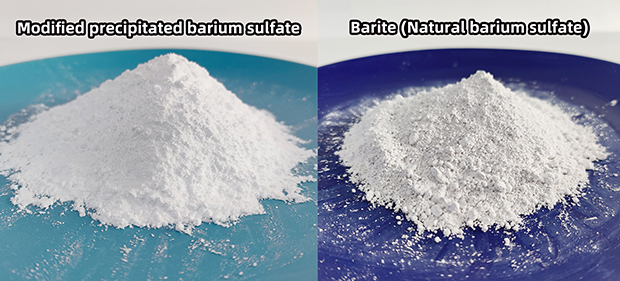
Barite (Natural barium sulfate) is made by physical method, while our precipitated barium sulfate product is made by chemical reaction, and the two are quite different in terms of performance index and price. If you want to know more information, welcome to consult us!